Bio & C.V.
Jesper N. Wulff is Professor at the Department of Economics and Business Economics, Aarhus University. His work is situated at the intersection of business analytics, applied statistics, organizational research methods, and computational social science. He develops and evaluates quantitative methods for empirical research, with a particular emphasis on statistical and causal inference, generalized linear models, sensitivity analysis, and meta-science.
A central theme in Jesper’s research is the improvement of empirical practice in the social sciences. His methodological work addresses common statistical challenges faced by applied researchers, including the interpretation of nonlinear models, models for proportions and fractional outcomes, log-transformed dependent variables, sample-size-dependent significance thresholds, multiple imputation, robustness and replicability, and sensitivity to omitted confounding. Much of this work aims to make advanced statistical ideas practically useful for researchers working with real data, imperfect research designs, and substantively important questions.
Jesper’s research has been published in leading journals across management, international business, finance, public administration, and interdisciplinary social science. His publications include articles in Nature, Journal of Management, Organizational Research Methods, Journal of International Business Studies, The Leadership Quarterly, Public Administration Review, Journal of Corporate Finance, British Journal of Management, Strategic Organization, and The Lancet Public Health. His applied collaborations span corporate finance, social epidemiology, and public administration, reflecting a broader interest in how rigorous quantitative methods can improve evidence across fields.
In addition to his journal publications, Jesper develops software and practical tools for researchers. He is the creator of the R package alphaN, which helps researchers set significance levels as a function of sample size using a Bayesian-frequentist compromise, and he has developed web applications and teaching materials that make statistical methods more accessible.
Jesper is actively involved in academic service and research quality initiatives. He serves as Associate Editor and Methods Advisor at The Leadership Quarterly, Methods Consultant for the Journal of Management Methods Task Force, and Editorial Board Member for CARMA. Through these roles, he contributes to improving methodological standards, reviewing practices, and the use of quantitative evidence in management and organizational research. He also teaches and organizes workshops on advanced regression models, binary outcomes, interactions, endogeneity, panel data, sensitivity analysis, and AI for organizational research.
Teaching is a major part of Jesper’s academic profile. At Aarhus University, he teaches courses in generative AI, deep learning, machine learning, Bayesian data analysis, and scientific methods. He is programme coordinator for the MSc in Business Intelligence and has played an active role in developing and modernizing teaching in statistics, business analytics, and AI. His teaching has been recognized with the Aarhus BSS Lecturer of the Year Award, and his courses consistently receive high student evaluations.

Jesper also supervises PhD students, postdoctoral researchers, master’s theses, and research projects. His supervision and research leadership focus on developing independent scholars who combine strong methodological foundations with substantive curiosity and practical relevance. He has received external research funding for projects on interpretable machine learning and computer vision in finance, and he has contributed to large-scale collaborative projects on robustness and replicability in the social and behavioral sciences.
Jesper holds a PhD in Economics and Business Economics from Aarhus University, an MA in Social Science Data Analysis from the University of Essex, and an MA in Business Administration from Aarhus University. Across his research, teaching, software development, and academic service, his work is driven by a common objective: to help researchers, students, and organizations use data, statistics, and AI more carefully, transparently, and effectively.
Curriculum vitae
Appointments
- 2025– Professor, Department of Economics and Business Economics, Aarhus University
- 2019–2025 Associate Professor, Aarhus University
- 2015–2019 Assistant Professor, Aarhus University
Education
- 2015 PhD, Economics and Business Economics, Aarhus University
- MA, Social Science Data Analysis (with distinction), University of Essex
- 2011 MA, Business Administration, Aarhus University
- 2009 BSc, Management, Aarhus University
Selected honours
- 2026, 2023 & 2018 Best Paper, Research Methods Division, Academy of Management
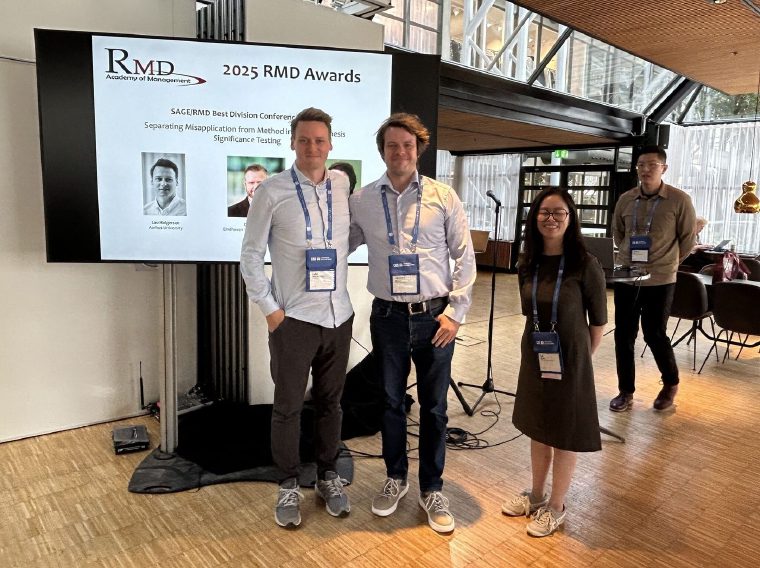
- 2025 SAGE/RMD Best Division Conference Paper Award, Academy of Management
- 2022 Academy of Management Fellows’ Award for Responsible Research in Management
- 2018 Lecturer of the Year, Aarhus BSS
Editorial & academic service
- Associate Editor and Methods Advisor, The Leadership Quarterly
- Methods Consultant, Journal of Management Methods Task Force
- Editorial Board Member, Consortium for the Advancement of Research Methods and Analysis (CARMA)
- External examiner in statistics and data analysis, Danish Corps for External Examiners in Business Economics